
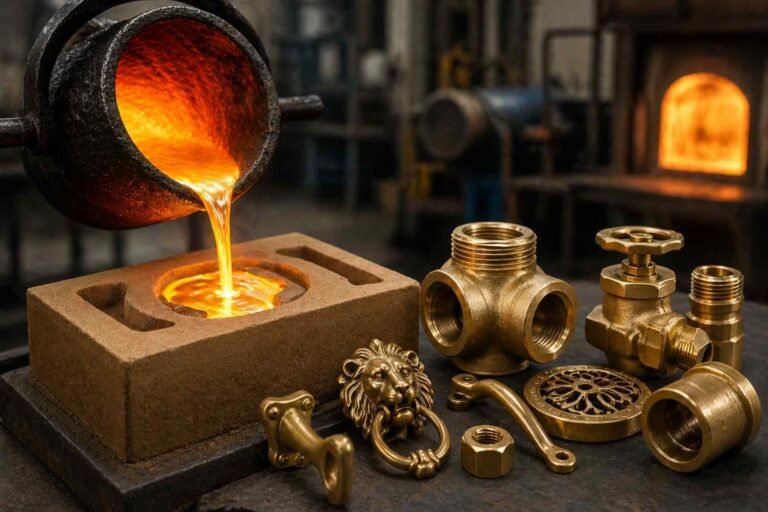
Brass casting is a widely used manufacturing process in which molten brass (an alloy of copper and zinc) is poured into molds to create strong, durable, and complex components. It is valued in engineering and industry for its versatility, corrosion resistance, and smooth finish.
Brass casting process
- Pattern making: A model of the final product is created using wood, plastic, or metal
- Mold preparation: A mold is formed around the pattern, usually using sand
- Melting: Brass is heated in a furnace until it becomes molten
- Pouring: The molten brass is poured into the prepared mold
- Cooling: The metal cools and solidifies into the desired shape
- Finishing: The final product is cleaned, polished, and machined if needed
Types of brass casting
- Sand casting: Cost-effective and suitable for large or complex parts
- Die casting: High precision and smooth surface, ideal for mass production
- Investment casting: Used for highly detailed and accurate components
Applications
- Plumbing: Valves, taps, and pipe fittings
- Electrical: Connectors, terminals, and switches
- Automotive: Radiator parts, bearings, and bushings
- Marine: Corrosion-resistant ship components
- Decorative: Door handles, hardware, and artistic items
Key benefits
- Corrosion resistance: Performs well in moist and harsh environments
- Easy machining: Simple to cut, shape, and finish
- Durability: Strong and long-lasting material
- Aesthetic appeal: Attractive gold-like appearance
- Recyclability: Environmentally friendly and reusable
Conclusion
Brass casting is a reliable and efficient manufacturing method that produces high-quality components for various industries. Its combination of strength, flexibility, and cost-effectiveness makes it an essential process in modern engineering.